Effect of Complete Street Projects on Physical Activity and Its Mediators: A Scoping Review
This is a scoping review that aims to explore the impact of Complete Street projects on physical activity levels and identify potential mediators influencing this relationship. By systematically reviewing the literature, the study seeks to provide an overview of existing evidence, highlighting key findings on how these infrastructure interventions affect physical activity. Additionally, the review examines factors that may mediate these effects, such as roadway crash, speed, air quality, etc. The findings are intended to inform policymakers and practitioners about the effectiveness of Complete Street projects and guide future research to address gaps in understanding.
Complete Streets, Physical Activity, Scoping Review, Mediators
1 Introduction
Outdoor physical activity (PA) is a well-established strategy to improve public health and prevent chronic diseases such as cancer, cardiovascular disease, diabetes, and obesity. Regular Active transport (AT) activities, such as walking and bicycling, can shape a healthy lifestyle for individuals and contribute significantly to their daily PA levels. Individual’s AT behavior is significantly influenced by the built environment, especially transportation infrastructure. Intervention from transportation infrastructure can promote outdoor PA by directly redesigning and providing facilities (e.g., sidewalks, bike lanes, and shared-use paths) that support walking and bicycling and indirectly by enhancing safety, accessibility, and connectivity of the AT network. Previous studies have demonstrated the significant impact of built environment on AT, including direct impacts of PA through provisions of supportive transportation infrastructure and environmental amenities (Lee and Moudon 2008; O. Ferdinand et al. 2012; Parker et al. 2013), and indirect impacts through PA mediators such as traffic speed and crashes (Dehghanmongabadi and Hoşkara 2021; Barnes and Schlossberg 2013; Dunn et al. 2025).
Complete Streets (CS) is a major movement promoting transportation infrastructure interventions that have been widely adopted across the United States over the past two decades. It is an approach to planning, designing, building, operating, and maintaining streets that enables safe access for all people who need to use them, including pedestrians, bicyclists, motorists, and transit riders (Smart Growth America 2015). It aims to redesign streets to accommodate all users, regardless of ability, ensuring pedestrians, bicyclists, transit users, and vehicle drivers can safely and equitably share the roadway (Geraghty et al. 2025). CS policies can take various forms, including formal regulation adopted by state or local governments, guidelines or recommendations from transportation agencies, and design standards incorporated into planning documents. It can also be a project involving a range of infrastructure improvements, such as road diet, adding sidewalks, bike lanes, traffic calming measures, and transit facilities. To date, more than 1,700 Complete Streets policies have been adopted across the United States, including by 37 state governments, the Commonwealth of Puerto Rico, and the District of Columbia (Smart Growth America 2025).
CS projects have been shown to offer significant benefits to PA and its mediators. PA mediators in this review refer to factors that can influence or mediate the relationship between CS projects and PA, such as roadway crash, speed, air quality, perception, and traffic volumes. These mediators can affect individuals’ willingness and ability to engage in PA by impacting safety, comfort, and accessibility. A theoretical framework illustrating the potential pathways through which CS projects can influence PA and its mediators is presented in the Figure 1. Residents most recently exposed to a CS intervention reported higher active travel than comparison groups, with proximity associated with increased pedestrian activity for both walking and bicycling, which suggests CS promote PA and provide public health benefits (Brown et al. 2016). Besides the direct effect on PA, CS projects can also influence PA through various mediators. For example, by reducing traffic speed, traffic volume, and roadway crashes, CS projects can create a safer environment for pedestrians and cyclists, thereby encouraging more people to engage in active transportation (Geraghty et al. 2025; Dunn et al. 2025; Savolainen et al. 2024). Improved air quality resulting from reduced vehicle emissions can also enhance the overall outdoor environment, making it more appealing for physical activity (Dehghanmongabadi and Hoşkara 2014). Additionally, positive perceptions of safety and satisfaction with the environment can further motivate individuals to choose active modes of transportation over driving (Maisel, Baek, and Choi 2021).
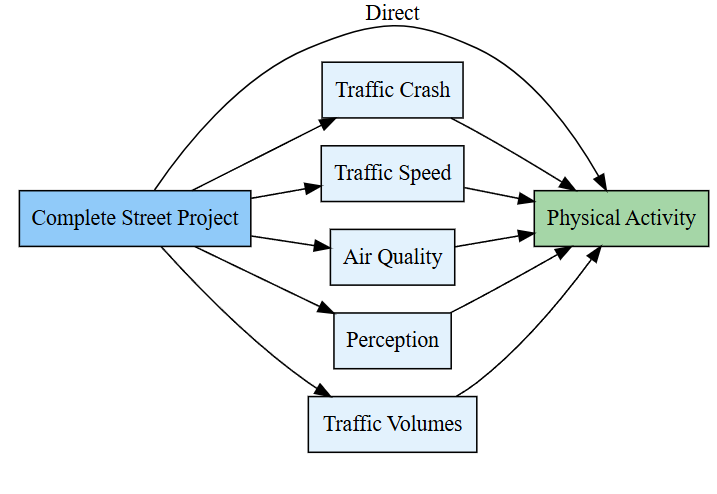
Revise later Although Complete Streets policies and projects have been rapidly adopted nationwide, rigorous empirical evaluations of their impacts remain scarce. Several hurdles hinder the empirical evaluation of CS projects, including xxx. This scoping review aims to fill this gap by systematically examining the literature on the impact of CS projects on PA levels and identifying potential mediators that influence this relationship. By providing an overview of current knowledge, this review seeks to inform policymakers, practitioners, and researchers about the effectiveness of CS interventions in promoting physical activity and improving public health outcomes. This scoping review examines how Complete Streets projects affect PA and its mediators that shape this relationship. By systematically reviewing the literature, it synthesizes evidence on the impact of infrastructure interventions on physical activity and identifies potential mediators—such as roadway crashes, vehicle speed, air quality, and similar factors. The findings are intended to inform policymakers and practitioners about the effectiveness of Complete Streets and to guide future research priorities.
2 Methods
2.1 Search strategy
This scoping review aims to identify existing empirical studies that evaluate the impact of CS projects on PA and its mediators. Drawing on the applied research nature of this line of work, the review focuses on peer-reviewed journal articles, conference papers, and technical reports that provide empirical evidence on the effects of CS projects. A comprehensive literature search was conducted across multiple databases, including PubMed, Web of Science (WOS), and Transport Research International Document (TRID). PubMed and WOS were selected for their extensive coverage of health and social science literature, while TRID was chosen for its coverage on journal articles, conference papers, and technical reports in the transportation field. Because queries using “Complete Streets” plus additional keywords returned few results, we used a single wildcard search term “complete street*” to capture relevant studies more comprehensively. This query gives us references that may not fit the scope of this review, but we exclude those irrelated ones in the screening process. The search was limited to studies published in English from January 2000 to September 2025, reflecting the period during which Complete Streets policies and projects have gained prominence.
2.2 Literature screening and selection
The literature review screening process is shown in Figure 2. The initial search yielded 719 records from the three databases: 42 from PubMed, 210 from WOS, and 467 from TRID. These records were imported into Covidence for deduplication and screening. After removing 102 duplicates, there were 617 unique records for title and abstract screening. Two reviewers from the team independently screened the titles and abstracts against predefined inclusion and exclusion criteria. Studies were included if they (1) evaluated Complete Streets projects, (2) assessed physical activity outcomes or mediators related to physical activity, (3) were empirical studies (quantitative, qualitative, or mixed methods), and (4) a before-and-after study with the CS intervention. Studies were excluded if they (1) were not related to Complete Streets projects (e.g., policy or regulation at state level), (2) did not assess physical activity or its mediators, (3) were reviews, commentaries, or theoretical papers, (4) were not conducted in the United States. Any discrepancies between reviewers were resolved through a discussion of the two reviewers. After title and abstract screening, 98 articles were selected for full-text review. The full texts of these articles were then assessed for eligibility based on the same inclusion and exclusion criteria. Following the full-text review, 14 articles and research reports met all criteria and were included in the final analysis.

2.3 Data extraction and synthesis
revised laterA standardized data extraction form was developed to systematically collect relevant information from the included studies. The form captured details such as study characteristics (e.g., authors, year, location), study design (e.g., cross-sectional, longitudinal), sample size, types of Complete Streets interventions, physical activity outcomes measured (e.g., walking, bicycling), mediators assessed (e.g., traffic speed, crashes, air quality), key findings, and limitations. Two reviewers independently extracted data from each study to ensure accuracy and consistency. Any discrepancies were resolved through discussion and consensus.
3 Results
3.1 Overview of included studies
- Overview of the study
- CS projects
- Framework of CS effect on PA